

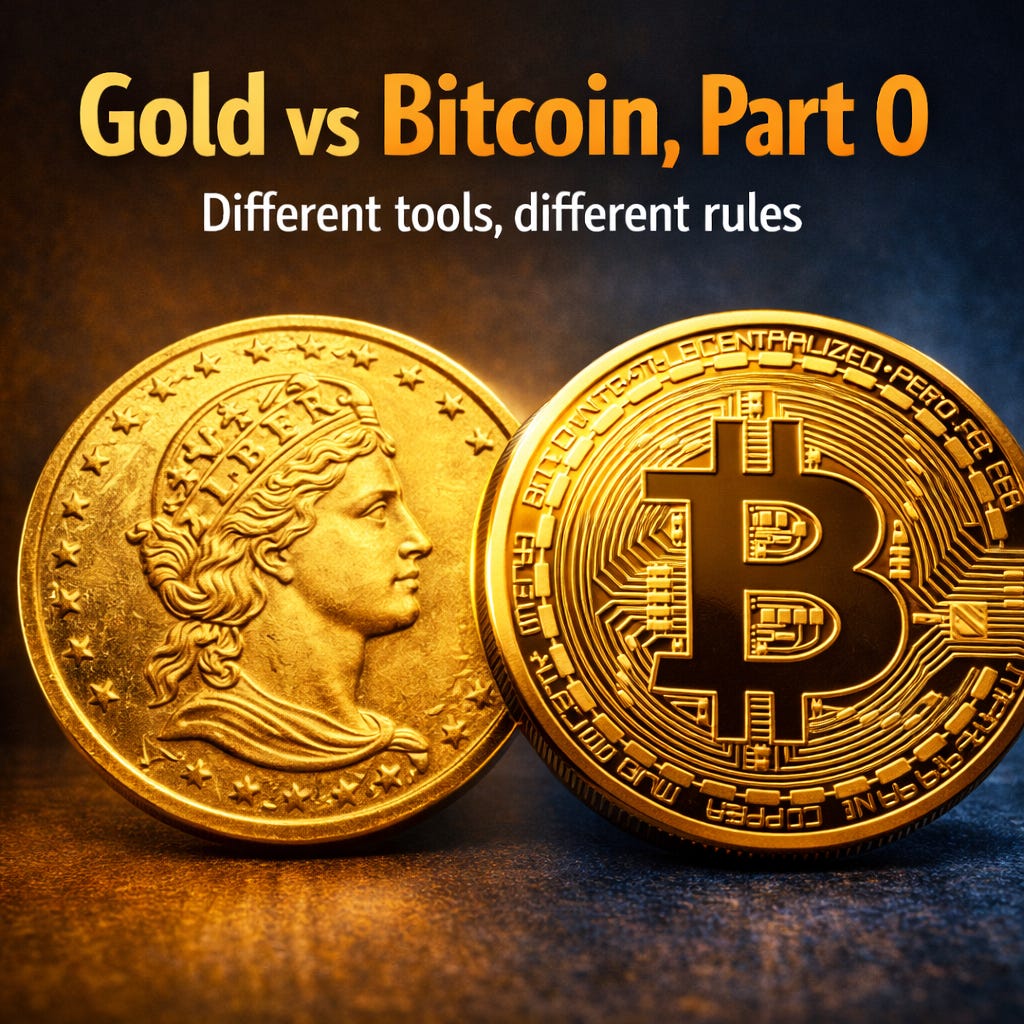
Gold vs Bitcoin, Part 0
Different tools, different rules

Every year my wife and I send Christmas cards to our friends and family. We buy a stack of envelopes and cards, write heartfelt messages (with a pen!), and sign our names. My wife’s signature is that of a beautiful artist, because she actually is one. Mine is sloppier than a third grader’s, but together they make it clear the card came from both of us.
Of course, we could send Christmas emails instead. I remember when email Christmas cards were popular in the late 90s. They were animated, funny, and I used to laugh at them. But does anyone still use those? I don’t.
That doesn’t mean email isn’t important. I use email far more often than I send letters. In fact, you are probably reading this in your inbox right now.
Most of us live with one foot in the old world and one foot in the new. Email exploded in the past thirty years, yet the post office remains. Digital didn’t eliminate the old system. It added another layer.
The same is true for Bitcoin and gold. They are not competitors. They are complementary forms of hard money. Gold isn’t going anywhere, but Bitcoin adds the second signature needed on the Christmas card of sound money.
The Problem With Government Currency
Some people may wonder why we need Bitcoin or gold at all when we already have a strong world reserve currency like the U.S. dollar. But the dollar relies on wise management from the Federal Reserve and the federal government. The Federal Reserve must manage the money supply and interest rates responsibly, while the federal government must control spending and keep the budget under control.
When a government overspends, rather than allowing it to default, the central bank prints money to inflate away the debt. If this process is not brought under control, it leads to hyperinflation. 1
Rather than relying on governments and central banks to manage currency wisely, we need forms of hard money they cannot alter.
Bitcoin Is Like Email
The need for a hard digital currency is self-evident. In the United States, over 80% of payments are digital. 2 Yet they rely on an inflating dollar backed by a government with an out-of-control spending problem. Gold cannot be spent online without using an intermediary, which creates counterparty risk. Someone must store and manage the gold on your behalf. Bitcoin solves this problem by providing a hard digital currency for the 21st century.
Here are some of the things Bitcoin makes possible:
• Online payments and international business with instant, final settlement.
• A digital currency without counterparty risk.
• A payment network that is not controlled by any government or megacorporation.
• A digital asset with a limited supply that cannot be created with a few taps on a keyboard (I am looking at you, Federal Reserve). 3
This does not mean traditional in-person payments will disappear; after all, we still send Christmas cards.
Gold Is Like Paper
Bitcoin will become the dominant system for making digital payments. But gold is here to stay. Here is why gold still matters:
Governments will want to back up their wealth with a traditional asset, “just in case.” Just as important files are backed up with paper copies, nations will want physical gold reserves in case digital systems fail.
Gold will always be needed for industrial, artistic, ceremonial, and medical uses.
There is an emotional weight to holding a tangible asset that has held value for thousands of years.
Some people will always reject modern technology and refuse to use digital payment systems. If cash ever disappears, traditional metals like gold will take its place.
Why We Need Both Bitcoin and Gold
To truly escape government currency and the problems it creates, we need both Bitcoin and gold. If we only have gold, we eventually end up relying on fiat currency again. The problems with gold include:
It’s heavy and difficult to move, which makes international payments impractical.
Online payments require a third party to hold your gold, creating counterparty risk.
It does not divide well for small purchases (imagine buying a piece of chewing gum with gold).
This is why fiat currency developed in the first place. Gold could not solve modern payment problems on its own, so fiat systems emerged to fill the gap.
But if we only have Bitcoin, we face a different problem. We would have no way to opt out of the digital world and no backup plan if something goes wrong with AI, the internet, or digital infrastructure.
The ideal system uses both. Bitcoin solves the problems of digital payments, while gold provides a physical fallback. Together they remove the need for fiat currency and open the door to rolling back government control over the economy.
Conclusion
By holding both gold and Bitcoin, we get the best of both worlds: hard physical money and hard digital money.
In the past, we had to rely on banks and other counterparties to hold our wealth, giving governments significant control and creating opportunities for others to profit at the expense of ordinary people.
That system is no longer inevitable. A society that embraces Bitcoin while still holding some gold can move beyond it. Gold and Bitcoin are the two signatures on the Christmas card of sound money.
Crypto Taxes Are Coming
If you’re trading or investing in crypto, taxes are part of the deal. Tracking everything across wallets and exchanges can get messy fast. I personally use TokenTax to organize my transactions and generate my reports. If you’re looking for a tool to help with crypto taxes, check them out here.
Final Word
Don’t fight over what’s better. Just hold both.
It is well enough that people of the nation do not understand our banking and monetary system, for if they did, I believe there would be a revolution before tomorrow morning." — Henry Ford
Disclaimer:
The information in this publication is for educational purposes only and does not constitute financial, investment, or legal advice. Always do your own research before making any financial decisions. Cryptocurrency investments carry risk, and past performance is not indicative of future results. I actively invest and trade in the crypto markets, and my personal portfolio and holdings change frequently. Nothing I share should be interpreted as a guarantee of performance or a recommendation to buy or sell any asset.
https://www.investopedia.com/ask/answers/042015/how-does-money-supply-affect-inflation.asp
https://www.frbservices.org/news/research/2025-findings-from-the-diary-of-consumer-payment-choice
https://bitcoin.org/bitcoin.pdf
In the 1970s, the 'Rolling Stones versus Led Zeppelin' debates were fierce. Some Stones fans refused to buy Led Zep albums and vice versa. Nowadays it seems silly.