

Gold vs Bitcoin, Part 4
Gold Can Be Debased. Bitcoin Cannot.

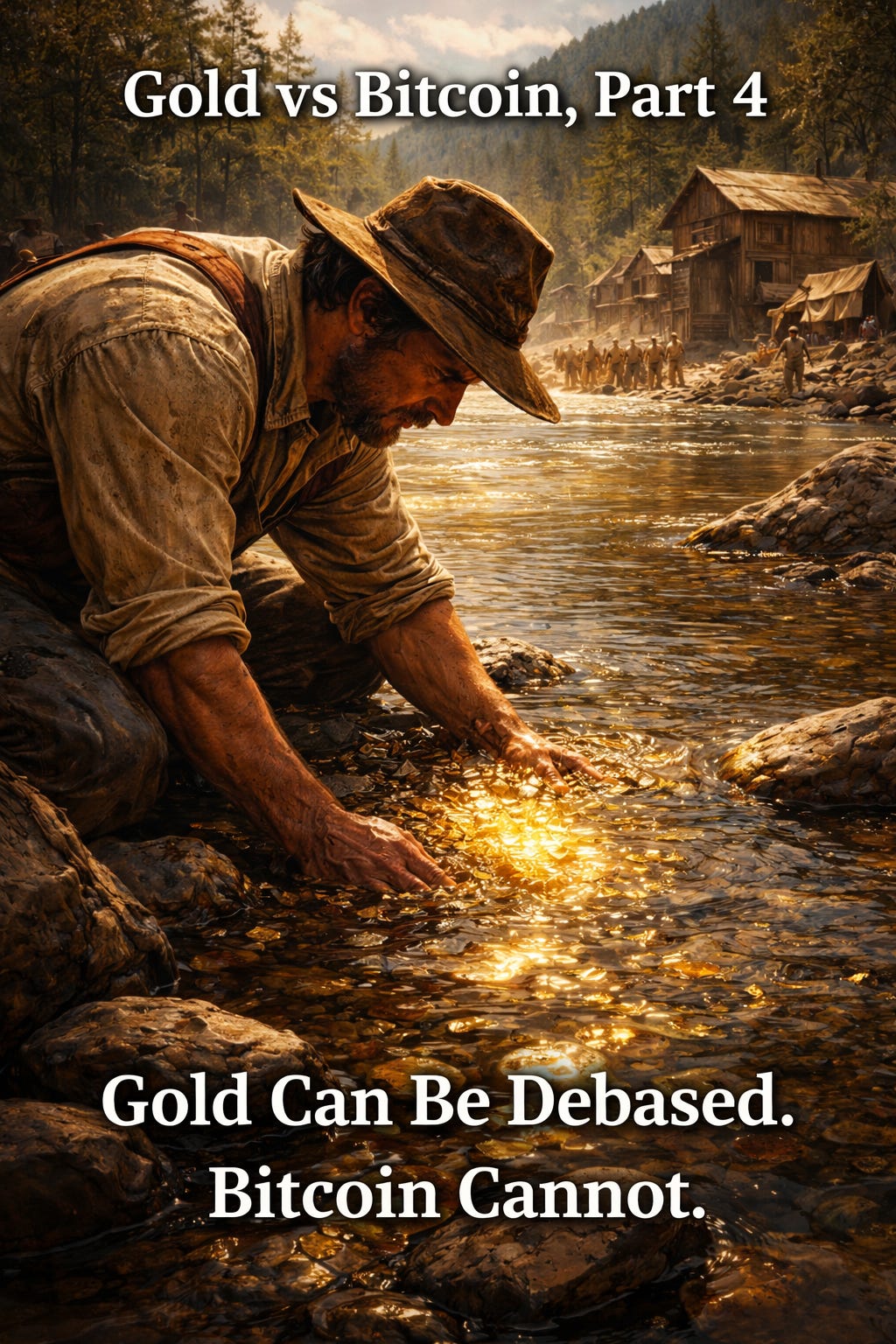
It was just another day, until he looked into the water.
January 1848. James Marshall stood along the South Fork of the American River in northern California. He was building Sutter’s Mill and inspecting the channel to make sure the water flowed properly and the ditch wasn’t eroding. Then something caught his eye. Yellow flakes.
Could it be gold?
After some initial testing, gathering the flakes and hammering them together, Marshall confirmed it was gold. He brought the discovery to John Sutter, 1 who owned the land and the mill. Neither of them wanted this to get out. They knew exactly what it would bring.
They tried to keep it quiet.
They failed.
Word spread, and within a year more than 80,000 men poured into California, tearing through the land in search of the same gold Marshall had found in the water.
Between 1848 and 1855, miners extracted nearly 750,000 pounds of gold,2 worth over $50 billion in today’s money. A few flakes in the water became a flood of new supply.
The Problem of Debasement
Finding gold is one problem, but what you do with it is another.
In the 1300s, in Cairo, Mansa Musa passed through the city on his pilgrimage to Mecca, handing out gold along the way. Some accounts say he brought 100 camels, each carrying 300 pounds, and gave it away freely. 3 The city celebrated as wealth seemed to appear out of nowhere.
He believed it was a blessing.
But something went wrong. There was suddenly too much gold in Cairo. Prices shifted, and gold wasn’t worth what people thought it was. It got so bad that Mansa Musa tried to undo it, borrowing gold at high interest just to pull it back out of the market. 4 The damage didn’t stay in Cairo. It spread throughout the known world.
Mansa Musa’s problem wasn’t a lack of generosity. It was flooding the market with gold.
Gold’s Supply
After everything that happened in Cairo, you might think gold is everywhere.
It isn’t. It feels that way because we see it so often.
We wear it on our wedding rings. It’s in our jewelry and our electronics. It’s been mined for thousands of years. And yet, if all the gold in the world were gathered together, it would fit inside a small apartment building in Manhattan, only about seven stories tall. You could walk around it in just a few minutes.
But the supply of gold isn’t fixed.
Since 1950, roughly two-thirds of all the gold ever mined has been created, and the supply is still growing. 5 There are entire asteroids made of metal, like 16 Psyche, orbiting between Mars and Jupiter. 6 We know it is rich in iron, and metals like gold are often found alongside it. It hasn’t been fully explored.
We don’t know what’s there. What we do know is this: there is no ceiling on how much gold could exist.
The 49ers showed how quickly gold can be found. Mansa Musa showed what happens when too much of it enters the market. If miners ever discovered a large deposit of gold on an asteroid like Psyche 16, the impact could be similar. Gold’s supply is never final.
Could Bitcoin’s supply face the same problem?
Bitcoin’s Supply
We don’t know how much gold exists. But we do know exactly how much Bitcoin there is, and ever will be. Bitcoin’s supply is fixed at 21 million coins, all of which will be mined by the year 2140. Even more surprising, about 99% of that supply will already be mined by 2032. 7
The Bitcoin gold rush is mostly over.
Instead of being scattered by the laws of physics, Bitcoin’s supply is set by math and code. The schedule is predictable. New Bitcoin is created roughly every ten minutes, and the amount issued is cut in half every four years in an event called the halving.
Some argue Bitcoin’s supply could be changed at any time because it’s just code.
But changing it would require overwhelming agreement across the network. Developers would have to rewrite it, miners would have to adopt it, and full nodes would have to accept it.
Even if Bitcoin’s supply were changed, everyone would see it. The new rules would be public, and the supply schedule would be clear.
Bitcoin’s supply is never a mystery.
Conclusion
Both gold and Bitcoin are scarce, but Bitcoin’s supply is known while gold’s supply is governed by the laws of physics. For the first time in human history, we have a valuable asset with a fully transparent and predictable supply. The problem of uncertain supply has been solved, not by nature, but by code and mathematics.
Final Word
Nobody but God knows how much gold exists.
“As computers get faster and the total computing proof-of-worker applied to creating bitcoins increases, the difficulty increases proportionally to keep the total new production constant. Thus, it is known in advance how many new bitcoins will be created every year in the future.”
― Satoshi Nakamoto
Disclaimer:
The information in this publication is for educational purposes only and does not constitute financial, investment, or legal advice. Always do your own research before making any financial decisions. Cryptocurrency investments carry risk, and past performance is not indicative of future results. I actively invest and trade in the crypto markets, and my personal portfolio and holdings change frequently. Nothing I share should be interpreted as a guarantee of performance or a recommendation to buy or sell any asset.
https://historynet.com/john-sutters-california-dream-became-his-worst-nightmare/
https://www.history.com/articles/gold-rush-of-1849
https://www.worldhistory.org/Mansa_Musa_I/
https://himiespa.feb.ugm.ac.id/mecca-pilgrimage-of-mansa-musa-when-generosity-caused-inflation/#:~:text=Knowing%20the%20situation%2C%20Mansa%20Musa,the%20world%20price%20of%20gold.
https://www.gold.org/goldhub/data/how-much-gold
https://science.nasa.gov/mission/psyche/science/
https://www.swanbitcoin.com/education/bitcoin-halving-dates/#:~:text=Given%20the%20current%20trajectory%2C%20Bitcoin,sometime%20around%20the%20year%202140.