

Bitcoin Myths, Part 8
Why Bitcoin Is Better for the Environment Than You Think

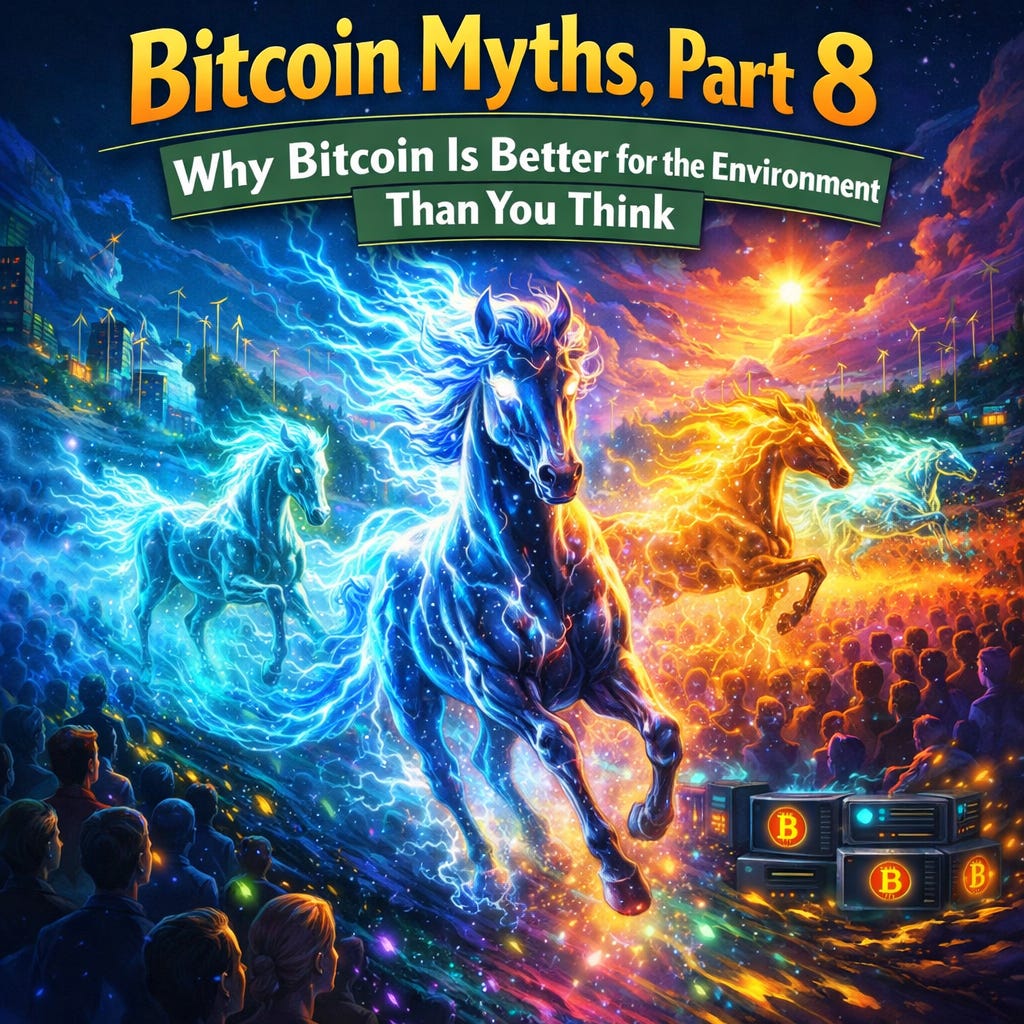
Louisville, Kentucky is home to the Kentucky Derby, the “two most exciting minutes in sports.” Every year, people from around the world flood the city to watch a single horse race and get rip-roaring drunk. For one week, Louisville transforms. Restaurants are packed, hotels are sold out, downtown is chaos, and traffic is unbearable. But the money is glorious.
Louisville’s economy runs on the Derby. In a single week, hotels can generate around 10% of their annual profits. 1 Restaurants often sell a month’s worth of food in just a few days. And if you have any kind of side hustle, this is your opportunity. For one week, the entire city gets an economic shot in the arm.
So no matter how much locals wish the drunks would go home, the money is too good to pass up.
The Problem of Green Energy
Green Energy is a lot like Louisville, Kentucky. It can be profitable on its own, but it needs an extra boost to truly thrive. Wind, solar, and hydro all share the same underlying challenge: their output depends on conditions they can’t control.
So what happens when they produce too much energy? The grid can’t absorb it, and current battery systems aren’t efficient enough to store it at scale. As a result, excess energy is wasted and profits are lost.
Green energy loses money when:
Energy is wasted.
Too much supply crashes prices.
Power is stranded far from where it’s needed.
Green energy optimists point to batteries as the solution. And yes, after billions of dollars and decades of research, they have improved. But we still cannot economically store days, let alone seasons, of excess energy. 4
Bitcoin to the Rescue?
What if green energy had a “Kentucky Derby” event? An economic shot in the arm that generates more profits? A buyer of last resort that shows up when needed and leaves the moment it is no longer needed.
Bitcoin mining is perfect for this job. Miners are portable and only need power and internet, so they can operate in remote locations. They can turn on and off instantly, using electricity only when it is available. When there is excess energy, miners put it to work and generate revenue. When energy is scarce, they shut down just as quickly. It is the Kentucky Derby effect, but the drunks leave the moment they are not wanted.
But why would miners shut down? Don’t they want to make money at all times? Of course they do. But when electricity demand is high, prices rise and mining becomes unprofitable. When there is excess energy, that power is sold at a discount, which creates an opportunity for miners. The power plant may not earn as much as it would during peak demand, but something is better than nothing.
Bitcoin Mining is Like Water
It is true that Bitcoin uses a lot of electricity. By many estimates, it consumes as much power as a country like Argentina. 5 But how it uses that power is not what most people think.
Did you know that some estimates put over 50% of Bitcoin mining on renewable energy? 6 And that since 2020, estimates suggest it has grown from roughly 35% to potentially as high as 60%? 7 This does not mean Bitcoin mining is fully green or never uses fossil fuels. But the trend is clear. Mining follows the cheapest energy, and that often leads to underutilized or stranded renewable sources that need economic support.
Bitcoin mining is like water. It always seeks the lowest place (or in this case, the lowest price). 8 The industry is highly competitive and pushes costs as high as possible. Mining does not survive where electricity is expensive. As a result, successful miners are forced to find the cheapest energy available. And some of the cheapest energy in the world is stranded or wasted green energy.
Conclusion
Many environmental activists oppose Bitcoin mining because of the energy it uses. But green energy needs a buyer of last resort for its excess power. Without buyers like this, many projects are less profitable and depend on government subsidies. If solar, wind, and hydro are going to replace oil and coal, they need to stand on their own economically. Bitcoin makes this possible by providing the “Derby effect.” It brings in needed money and leaves when it is no longer needed.
Tax Time
Green energy still needs subsidies, and those subsidies have to come from somewhere. Yes, that means taxes. The government appreciates your contribution.
In all seriousness, if you need help with your crypto taxes, check out TokenTax. It is the software I use to stay organized. If you use my link, you should get a discount, and I will receive a small referral fee as well. Check out TokenTax today.
Final Word
Happy upcoming Earth Day!
"Nothing in the world is as soft and yielding as water. Yet for dissolving the hard and inflexible, nothing can surpass it." — Laozi
Disclaimer:
The information in this publication is for educational purposes only and does not constitute financial, investment, or legal advice. Always do your own research before making any financial decisions. Cryptocurrency investments carry risk, and past performance is not indicative of future results. I actively invest and trade in the crypto markets, and my personal portfolio and holdings change frequently. Nothing I share should be interpreted as a guarantee of performance or a recommendation to buy or sell any asset.
https://www.wave3.com/2024/05/01/louisville-hotel-rates-sky-high-derby-150/
https://www.eia.gov/energyexplained/solar/
https://www.eia.gov/energyexplained/wind/
https://energyanalytics.org/the-battery-storage-delusion/
https://www.bbc.com/news/technology-56012952
https://cryptoslate.com/more-than-50-of-bitcoin-mining-uses-renewable-energy/
https://www.jbs.cam.ac.uk/2025/cambridge-study-sustainable-energy-rising-in-bitcoin-mining/
https://www.cnbc.com/2021/07/20/bitcoin-mining-environmental-impact-new-study.html