

Bitcoin Myths, Part 7
If You’re Not Buying Coffee With It, It’s a Failure

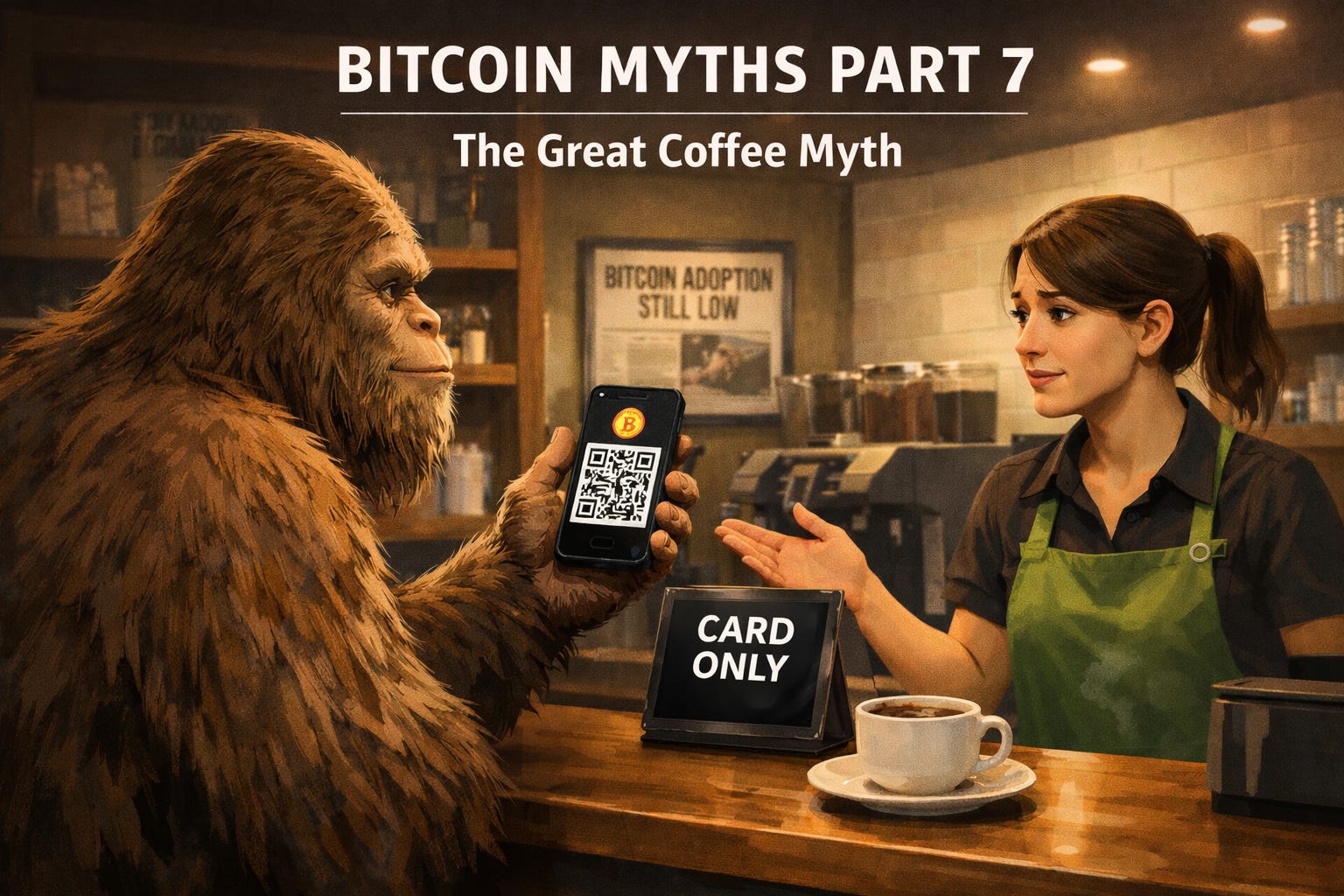
I went to Starbucks and ordered a macchiato. I offered a gold coin. She refused it. I offered a $100 bill. She wouldn’t accept it. Store policy.
I guess neither of those have value if I can’t buy coffee with them.
The Great “Coffee Myth”
Many people believe that because Bitcoin is not used for everyday payments like buying coffee, it has no economic value and does not function like money. Paul Krugman famously said “There is essentially no legitimate use for crypto… Fewer than 2% of Americans have ever made a payment in crypto."
He makes other claims about speculation, crime, and cult behavior. Those are separate myths and will be addressed in future Bitcoin Myths pieces.
Let’s go back to the coffee shop.
Most people would agree that a gold coin and a $100 bill are all forms of money. Yet everyone would call me a fool for trying to buy coffee with a gold coin. So money is not just a medium of exchange for buying things. It must be something more.
What is Money?
This is a subject you could spend a whole college class on. But traditionally, economists describe three things that money does. 1
Store of value. Money preserves purchasing power over time. You earn today and spend tomorrow.
Medium of exchange. Money is accepted in trade for goods and services.
Unit of account. Money acts as a measuring stick for value.
For something to be money it must be able to do all three, but that doesn’t mean it must do all three equally well.
Let’s see how the U.S. dollar measures up against its own standard.
How the Dollar Stacks Up
The U.S. dollar is a terrible long-term store of value. If you stuffed $1,000 under your mattress in 2015 and came back today, you would have lost over 30% of your purchasing power. Apparently that’s still good enough to qualify as money.
Many businesses are going cashless. 2 Cash carries security risks and most people use debit or credit cards. While cash is legal tender, that only means it must be accepted to settle a debt. A coffee shop selling lattes is not normally collecting on a debt. So does that mean cash is no longer a medium of exchange?
Finally, the dollar is also a weak unit of account over time. The M2 money supply has grown from roughly $12 trillion to over $22 trillion since 2015. 3 When the measuring stick itself keeps expanding, long-term price comparisons become distorted. But an imperfect unit of account does not mean it isn’t a unit of account.
The dollar fails all three tests to varying degrees. It's still money. Perfection isn't required.
Bitcoin Time
Paul’s mistake is pointing to low payment usage and concluding the whole thing has no legitimate use.
If the U.S. dollar, the “greatest currency in the world,” is imperfect in all three monetary functions, why is Bitcoin held to a higher standard? It doesn’t need to be flawless. It just needs to be different. Let’s apply the same test to Bitcoin.
Bitcoin as a store of value. The dollar melts slowly. Bitcoin swings violently. One steals from you over time. The other keeps you on edge in the short term. Inflation versus volatility. Both imperfect. Neither a reason to pretend it isn’t money.
Bitcoin as a medium of exchange. Bitcoin struggles as a medium of exchange for in-person transactions. Try paying for groceries with it and you’ll see what I mean. But online? Cross-border? Try moving money on a weekend without a bank in the middle. It shines in places critics conveniently ignore. Struggling in one lane doesn’t mean it fails the test.
Bitcoin as a unit of account. Try printing your menu in Bitcoin and updating it every second. The dollar is steadier in the short run. But that steadiness hides the constant supply expansion. Bitcoin does the opposite. The price bounces, but the rules don't. No central banker wakes up and decides there should be more of it.
Is it perfect? No. Does it offer something different? Absolutely.
Conclusion
If everyone held the dollar to the same standard Paul holds Bitcoin, we would have abandoned it by now.
Money has never been perfect. It has never been universally adopted overnight. And it has never been defined by whether you can buy a latte with it.
If the coffee test defined money, we’d have to disqualify the $100 bill too.
Final Word
I think it’s time to drink some coffee.
"The trouble with the world is not that people know too little; it's that they know so many things that just aren't so." — Mark Twain
https://www.investopedia.com/terms/m/money.asp
https://www.cbsnews.com/minnesota/news/can-businesses-refuse-to-accept-cash-laws/
https://fred.stlouisfed.org/series/M2SL?